


Malaysia’s crypto sector is drawing serious outside money. Bank Negara Malaysia has spent the past year rolling out sandbox pilots and tokenization roadmaps, and now one of the world’s biggest exchanges is backing a local platform to grow alongside it.
Bybit Returns With A Bigger Check
Bybit led an $8 million Series A round in Hata, a Kuala Lumpur-based digital asset exchange, with global family offices also putting money in.
It is not Bybit’s first bet on the company. The exchange previously led Hata’s $4.2 million seed round, making this a follow-on investment in a platform it already knows well.
According to the announcement, the new funds will go toward building liquidity, growing the user base, and adding more digital asset products.
Hata has been operating since 2023. In that time, it has signed up more than 209,000 registered users and processed roughly 1 billion Malaysian ringgit — about $225 million — in transaction volume this year alone.
For a licensed retail exchange still in its early years, those numbers show real momentum.

Two Licenses, One Platform
What sets Hata apart from many of its regional rivals is its regulatory standing. The platform holds licenses from both the Securities Commission Malaysia and the Labuan Financial Services Authority, which together allow it to offer trading and custody services for digital assets within the country.
That dual-licensed structure is uncommon and gives Hata a compliance foundation that unregistered offshore platforms cannot match.
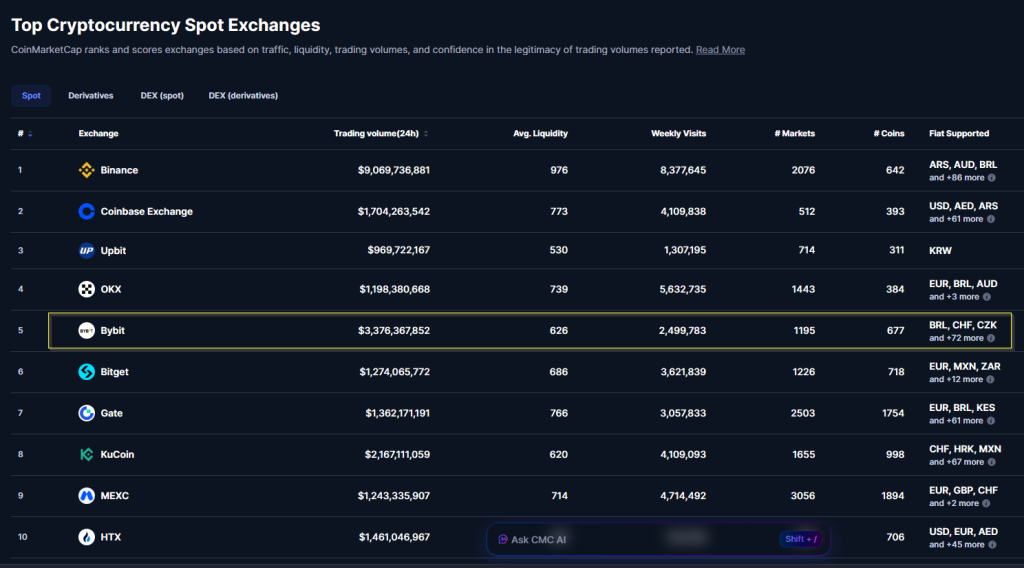
Source: CoinMarketCap
Bybit CEO Ben Zhou pointed to Malaysia’s appeal directly. He called the country strategically important and cited its digitally engaged population and strong long-term appetite for digital asset adoption.
Bybit, reports indicate, ranks as the fifth-largest crypto exchange in the world by trading volume.
Malaysia Builds Its Digital Asset Framework
The investment lands at a moment when Malaysian regulators are actively shaping the rules of the road for digital assets.
Bank Negara Malaysia launched a Digital Asset Innovation Hub as a regulatory sandbox, opening it up to fintech and crypto firms to test use cases — among them ringgit-backed stablecoins, programmable payments, and supply chain financing, all under central bank oversight.
The central bank has also outlined a three-year roadmap for asset tokenization. Institutions including Standard Chartered, CIMB Group, and Maybank are taking part in three sandbox programs focused on tokenized bank deposits and cross-border settlement.
A Malaysian telecom company linked to Crown Prince Ismail Ibrahim separately launched a ringgit-backed stablecoin called RMJDT on the Zetrix blockchain under the same framework.
Featured image from Pexels, chart from TradingView

Editorial Process for bitcoinist is centered on delivering thoroughly researched, accurate, and unbiased content. We uphold strict sourcing standards, and each page undergoes diligent review by our team of top technology experts and seasoned editors. This process ensures the integrity, relevance, and value of our content for our readers.


