


Global money supply surged to a fresh all-time high in December 2025, reinforcing a liquidity backdrop that has historically supported hard assets.
Gold has responded accordingly, maintaining its upward trajectory despite sharp but brief drawdowns. Nonetheless, Bitcoin, often described as “digital gold,” has delivered choppier price action.
Bitcoin’s Dual Identity Weighs on Price as Risk Appetite Fades
Global liquidity has continued to expand at a rapid pace. According to the Kobeissi Letter, global broad money supply rose to a record $144 trillion in December 2025. On a year-over-year basis, it increased by $13.6 trillion or 10.4%.
The December figure marked the third consecutive month of accelerating growth.
“Since the 2020 pandemic alone, money supply has surged +$44 trillion, or +44%. The fastest increase over this period was recorded in February 2021, at +18.7%. Global money creation has never moved this fast outside of a crisis,” the post read.
If global money supply is hitting an all-time high, the classic expectation would be: More liquidity → higher hard assets. Jurrien Timmer, Director of Global Macro at Fidelity, highlighted that gold is behaving according to that script while Bitcoin is not.
Timmer noted that despite volatility and a 21% drawdown earlier this month, gold has remained resilient. He said the metal has behaved as typically seen in a bull market, with sharp but short-lived pullbacks that quickly attract renewed buying interest.
“Gold may be the ultimate hard money asset and it has been following the global money supply in lockstep. Bitcoin is thought to be the same, but as the chart shows below, its price action vis-à-vis global liquidity has been a lot choppier than gold,” he said.
Follow us on X to get the latest news as it happens
Timmer explained that the reason for the disconnect is simple. According to him, gold is only one thing, i.e, “hard money.” Bitcoin, meanwhile, occupies a dual identity: a potential hard currency on one hand, and a speculative asset on the other.
The Fidelity executive further added that when the rate of change in the software and SaaS index is added to money supply growth, it becomes clear that when the speculative component of the market turns negative, it can easily override the liquidity tailwind that would otherwise support BTC.
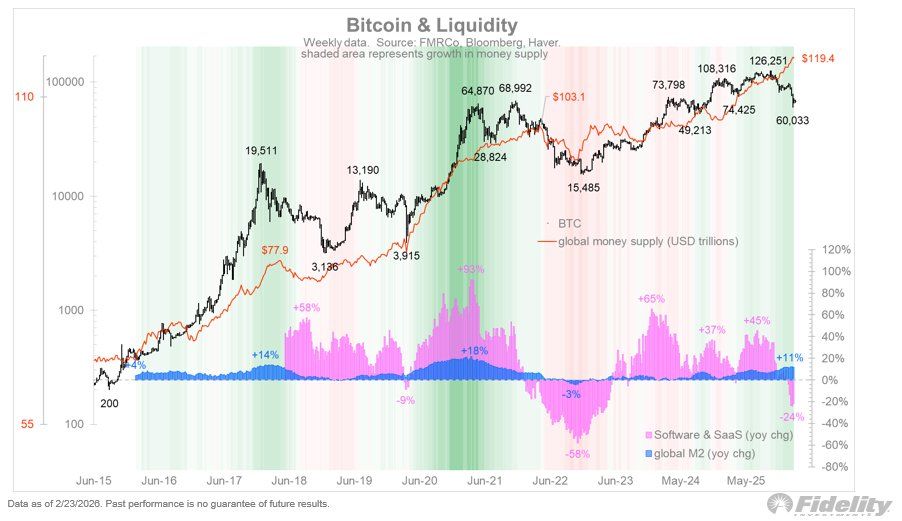
He noted that periods characterized by both expanding liquidity and strong speculative appetite have historically amplified bullish conditions. This often results in powerful bull markets. However, the dynamic works in reverse as well.
“Right now, we have ample liquidity growth but a bear market in speculation. The result: Bitcoin is languishing while gold and the money supply are rallying,” he remarked.
Subscribe to our YouTube channel to watch leaders and journalists provide expert insights
For now, the gap between gold and Bitcoin illustrates that rising liquidity alone does not guarantee crypto’s performance when speculative appetite is contracting. Whether Bitcoin will regain alignment with global liquidity likely depends on speculative interest returning to crypto markets, something that remains uncertain as February 2026 closes.


