


The crypto market is trying to hold above current price levels. Bitcoin and Ethereum are facing volatility. And beneath the price action, four separate data points are pulling in four separate directions — which is precisely why this moment is more complicated than it looks.
A CryptoQuant report has identified a market structure that defies simple characterization. Exchange netflows have turned positive for two consecutive days — shifting from -1,275 BTC to +682 BTC and then +428 BTC — meaning short-term sell-side supply is returning to exchanges after a period of net outflows. Simultaneously, open interest has climbed from $21.22 billion to $22.60 billion across three sessions, confirming that derivatives traders are rebuilding positions at scale.
Both of those developments would normally signal growing bullish conviction. The funding rate data refuses that interpretation. Funding has flipped from positive to negative and held there for two days — meaning the derivatives market is not overheated with aggressive longs but is instead reflecting cautious, two-sided positioning. Traders are opening positions without committing to a direction.
The market is not confused. It is hedged. That distinction matters because a hedged market does not move on sentiment alone — it moves when one side of the hedge is forced to cover. The data does not yet indicate which side breaks first.
Crypto Leverage Is Back
The report’s most consequential finding is the one that prevents a bullish reading of the open interest rebound. The 60-day USDT market cap change remains below zero — meaning that the stablecoin liquidity that fuels sustained price trends has not returned to the market in any meaningful quantity. Derivatives positioning is increasing. Spot demand is not confirming it. That divergence is the defining condition of the current environment.

The practical consequence is direct. When leverage rebuilds without liquidity support, price recoveries tend to be shallow and volatile rather than sustained and directional. The fuel for a trend continuation — fresh capital entering through stablecoins, new spot demand absorbing sell-side supply — is absent. What exists instead is a derivatives market rebuilding positions on top of a spot market that has not yet decided to participate.
The report translates this into a probability framework that deserves to be taken seriously rather than dismissed as false precision. Forty percent range-bound or neutral. Thirty-five percent short-term upside attempt. Twenty-five percent downside pressure. That distribution is not a forecast — it is a structured representation of what the four competing signals currently support.
The resolution conditions are equally specific. Upside confirmation requires exchange inflows to slow or reverse alongside a recovery in funding rates toward neutral. Downside risk escalates if inflows continue expanding while open interest rises and volatility increases. Neither condition has been met. The market is coiled between them — and this is not the moment to assume which way it uncoils.
The total crypto market cap is showing early signs of stabilization, but the weekly structure still reflects a market that has lost momentum after a strong expansion phase. Price is currently holding near $2.3 trillion, sitting between the 100-week and 200-week moving averages — a zone that often acts as a transitional range rather than a clear trend environment.
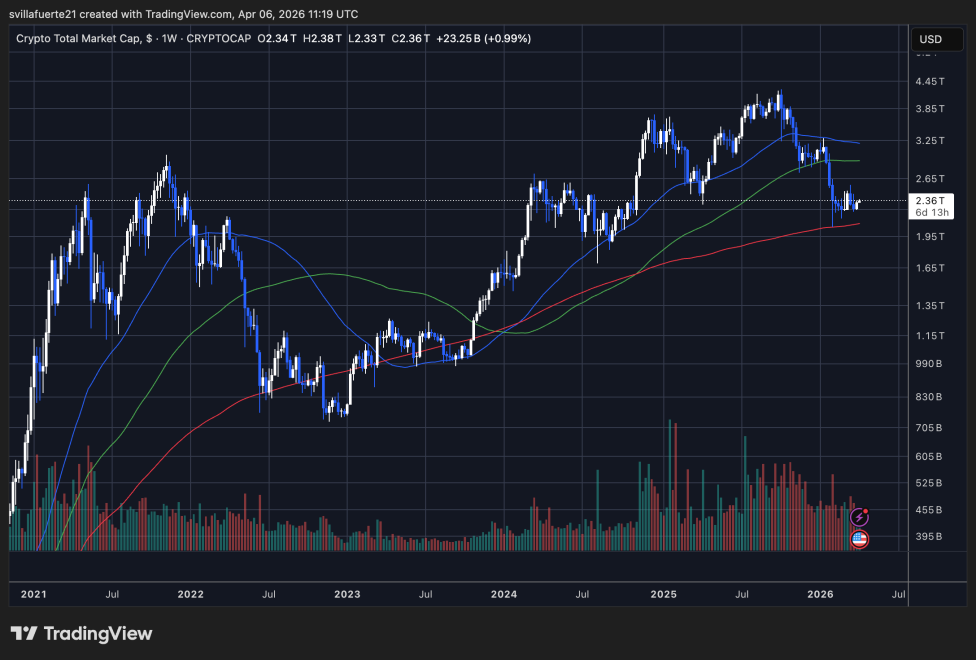
The rejection from the $3.8–$4.0 trillion region marked a decisive lower high, breaking the prior bullish sequence. Since then, the market has retraced sharply, losing the 50-week moving average and briefly testing the 200-week average before bouncing. That reaction confirms the 200-week as structural support, at least for now.
However, the recovery lacks conviction. The crypto market has not been able to reclaim the 100-week moving average decisively, and the 50-week average is beginning to slope downward, signaling weakening trend strength. Volume patterns reinforce this interpretation — large spikes during sell-offs, followed by relatively muted participation on rebounds.
This creates a fragile equilibrium. If the market cap reclaims the $2.6–$2.8 trillion region, it would signal renewed strength and open the path toward previous highs. Failure to do so keeps the structure range-bound, with downside risk toward the $2.0 trillion level if the 200-week support fails to hold.
Featured image from ChatGPT, chart from TradingView.com

Editorial Process for bitcoinist is centered on delivering thoroughly researched, accurate, and unbiased content. We uphold strict sourcing standards, and each page undergoes diligent review by our team of top technology experts and seasoned editors. This process ensures the integrity, relevance, and value of our content for our readers.


