

Vegas glitters differently when thirty thousand badge-wearing bitcoiners clog the marble concourses of the Venetian, screens flashing a frothy $105-to-106k tape for BTC, and every espresso line buzzing with “hash-rate” small talk.
Three-day festivals usually disperse into noise, yet this one distilled a single theme: the conversation has vaulted beyond legitimacy questions. Governments, regulators, and megacorps now jostle over integration, taxation, and monetisation.
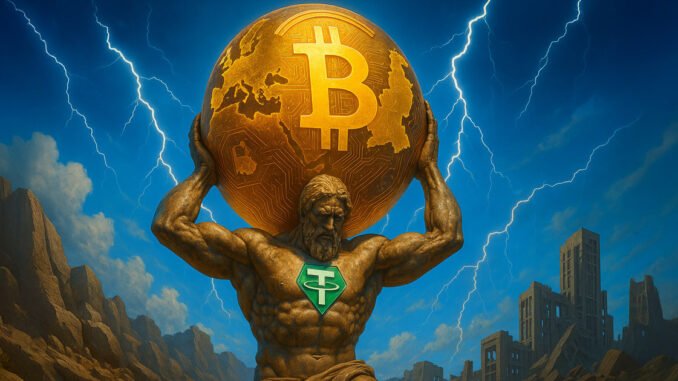
“Tether will be the biggest Bitcoin miner in the world,” Paolo Ardoino boomed, recounting $13 billion in profit and revealing “more than 100,000 Bitcoin that we own as a company,” before tossing off a maximalist haiku, “Bitcoin is perfect, gold is imperfect.” Investors inhaled the news of a further $2 billion sunk into energy projects, sensing a stable-coin juggernaut pivoting from liquidity plumbing to literal dig-the-ground infrastructure.
Bitcoin continues role as political campaigning prop
Across the aisle of national flags, Pakistan’s Special Assistant Bilal bin Saqib declared, “Today, I announce that the Pakistani government is setting up their own government-led Bitcoin strategic reserve … we will be holding these Bitcoins and will never sell them,” pairing that vow with 2 GW of surplus-power mining capacity.
Union Jacks popped next when Nigel Farage strode onstage, quipping, “We are the first political party in Britain that can accept donations in bitcoin,” and touting a draft bill slicing crypto CGT to 10 percent while wiring a “bitcoin digital reserve” into the Bank of England. The crowd roared, half for the policy, half for the spectacle of a Westminster veteran recruiting hodlers. Farage framed Westminster stagnation as an opening for a crypto-powered populist insurgency, promising a “crypto powerhouse” future.
However, with only five MPs and a recent poll putting Farage at the bottom of the pile of voter-preferred Prime Ministers, it’s the power of his rhetoric in ‘waking up’ the major political parties to the true importance of Bitcoin in his speech that is the most consequential here.
Regulatory mood music softened in tandem. SEC Commissioner Hester Peirce conceded, “We need to create a good environment for the good actors and a bad one for the bad actors,” warning that enforcement-by-ambiguity chases innovators offshore, and later hammered the point, “We can’t ignore it … value will eventually be incorporated into traditional financial products.” Her dry jab at meme traders, “If you want to speculate, go for it … don’t come complaining to the government”, drew cathartic laughs, yet signalled a pivot from obstruction toward rule-craft.
Bitcoin technical development takes a back seat amid world records
Builders matched the policy tempo. Ark Labs CEO Marco Argentieri unveiled Arkade, describing how it “virtualizes Bitcoin’s transaction layer, transforming it into a dynamic financial platform where operations happen instantly,” eliminating side-chains or wrapped tokens. Early partners span wallet apps to stable-coin titans, and a Q3 main-net launch looms, promising ninja-level programmability atop the ossified base layer.
Even the organisers chased headlines, firing up a GUINNESS WORLD RECORDS attempt for the most Bitcoin transactions in a single day, an on-chain carnival that pairs nicely with the conference’s hash-heavy, policy-hungry mood. As volunteers hustled cardboard signs reading “tap here, stack sats,” attendees queued to spam micro-payments, proving that the network’s culture is equal parts engineering sprint and street festival.
As attendees walked out into the Nevada dusk, some may have noticed that the narrative arc now resembles urban planning more than rebellion; zoning boards, tax codes, and energy grids are the new battlefields. That is progress of a sort, though one suspects the bitcoiners will miss the outlaw adrenaline once the paperwork sets in.
Other highlights from Bitcoin 2025
Michael Saylor delivered his keynote on the opening day of Bitcoin 2025. His “21 Ways to Wealth” speech was a highlight of the event’s Industry Day. Saylor emphasized Bitcoin’s role as a transformative financial asset and urged corporations to adopt it as a primary treasury reserve.
He stated, “Take your fiat currency, trade it for bitcoin… sell your bonds, sell your inferior real-estate property, buy bitcoin,” emphasizing his belief in Bitcoin’s superiority over traditional assets.
In other high-profile moments, Vice-President JD Vance laid out a Strategic Bitcoin Reserve as the next plank of American resilience, declaring that financial sovereignty now outranks budget scare-mongering in Washington’s pecking order.
Miles Suter followed with a Square-powered demo, insisting, “Bitcoin isn’t just something to hold anymore, it’s something to live on”, while free-speech banners then framed Donald Trump Jr.’s chat with Rumble chief Chris Pavlovski. The duo pitching uncensorable money plus uncensorable media as the movement’s new culture-war flank.
Robinhood founder Vlad Tenev sketched an AI-fuelled future of single-person companies and tokenised equity, arguing that permission-less capital will puncture gatekeeper cartels just as decisively as Bitcoin battered remittance fees.
Finally, White House crypto czar David Sacks reminded attendees that presidential authorisation already exists, adding, “If either Treasury or Commerce can figure out how to fund it without adding to the debt, then they are allowed to create those programmes”.
However, for all the posturing, the US Bitcoin strategic reserve continues to be a promise not to sell seized Bitcoin rather than a monetary policy. If the government takes your Bitcoin, it won’t dump it into the market anymore, but it still has no official policy to actually buy Bitcoin.
Is Bitcoin still Cypherpunk?
I can’t shake the lingering concern that the keynotes focused almost entirely on Bitcoin propaganda and political posturing rather than protocol development, security, and decentralization. While I’m all for helping to educate the world on the importance of Bitcoinization, I’m wondering how the Bitcoin Conference headliners are doing that.
Indeed, the headline talks energized the Bitcoin faithful in America, but I worry we’re straying further and further from the cypherpunk ethos of Bitcoin’s origin. Populist politicians with minor government roles continue using Bitcoin to garner votes while corporations celebrate their Bitcoin stacks.
Is this still Satoshi’s Bitcoin? I think so, but we must continue to remind ourselves why we love Bitcoin and whether we’re truly advancing the next one billion users or simply patting ourselves on the back for how high the price is this week.
Mentioned in this article


