


Bitcoin has slipped below the key $70,000 level and is now attempting to stabilize above $65,000 as broader market conditions remain fragile. The recent decline reflects persistent selling pressure, cautious investor positioning, and ongoing uncertainty around macroeconomic trends that continue to influence liquidity across risk assets. While volatility is not unusual at this stage of the cycle, the inability to quickly reclaim lost ground has kept sentiment defensive.
A recent CryptoQuant report from XWIN Research Japan adds important macro context. US retail sales for December came in below expectations in both the core metric and the retail control group, pointing to a meaningful slowdown in consumer spending. Because consumption remains the primary engine of the US economy, this data is increasingly viewed not as temporary noise but as a potential inflection point in the broader business cycle.
Within this framework, the report characterizes Bitcoin as being in a corrective phase embedded within a broader bearish trend. Downside risks remain conditionally dominant, particularly if financial conditions tighten further or capital flows into risk assets continue to weaken. However, the outlook remains sensitive to shifts in liquidity, policy expectations, and institutional demand, factors that could still influence Bitcoin’s medium-term trajectory despite current pressure.
The report also highlights a deteriorating macro backdrop that continues to shape Bitcoin’s market behavior. Recent data point to simultaneous slowdowns in both consumer spending and wage growth. The downside surprise in US retail sales increases risks to corporate revenues and employment trends, while the Employment Cost Index (ECI) came in below expectations, signaling easing wage inflation.
This combination tends to shift the Federal Reserve’s focus toward growth risks, but it can also maintain pressure on risk assets as economic momentum cools.
Manufacturing employment adds another layer of concern. The sector has been in a gradual long-term decline, often interpreted as a cyclical recession signal. When combined with softer consumption data and moderating wages, the broader picture suggests a phase of disinflation occurring alongside slowing economic growth rather than a rapid recovery.
Within this environment, Bitcoin remains susceptible to short-term risk-off moves, often behaving similarly to equities when liquidity tightens. Although expectations of eventual monetary easing can trigger rallies, the sustainability of those rebounds remains uncertain. Notably, the Coinbase Premium Gap has stayed persistently negative since late 2025, indicating weak US spot demand and price action driven largely by derivatives.

A sustained shift toward positive premium levels, supported by ETF inflows, would likely be required to materially improve the outlook.
Bitcoin Tests Critical Support As Weekly Structure Weakens
Bitcoin’s weekly chart shows clear deterioration in price structure after losing the $70,000 level, with BTC now attempting to stabilize around the mid-$60,000 range. The breakdown below this psychological threshold marks a shift from consolidation to a more defensive market posture, especially as price trades beneath shorter-term moving averages that previously acted as dynamic support.
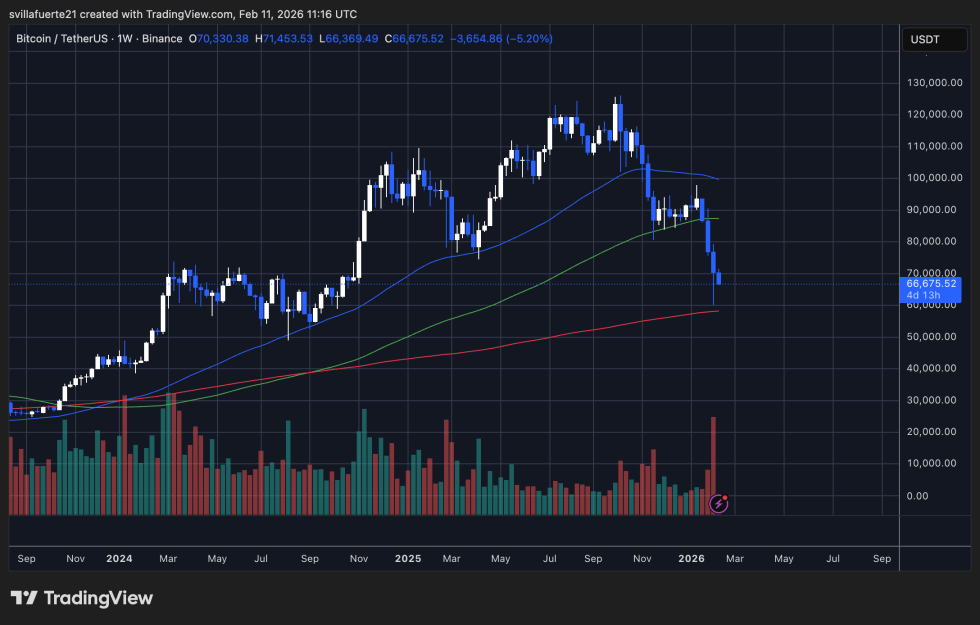
Momentum indicators inferred from price behavior suggest declining upside strength. Recent candles show persistent selling pressure, with lower highs forming since the late-2025 peak. Volume spikes accompanying the latest drop reinforce the idea of distribution or forced deleveraging rather than orderly profit-taking. Historically, such patterns tend to precede either extended consolidation phases or further corrective moves unless strong spot demand reappears quickly.
From a structural perspective, the next relevant support zone appears near the $60,000 region, roughly aligned with longer-term trend support and prior high-liquidity trading ranges. Holding above this level would preserve the broader bullish market structure despite the correction. Failure to do so, however, could open the door to deeper retracement scenarios.
Featured image from ChatGPT, chart from TradingView.com

Editorial Process for bitcoinist is centered on delivering thoroughly researched, accurate, and unbiased content. We uphold strict sourcing standards, and each page undergoes diligent review by our team of top technology experts and seasoned editors. This process ensures the integrity, relevance, and value of our content for our readers.


