
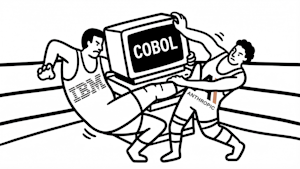
On Tuesday, Anthropic published tools that let Claude read, analyze and translate legacy COBOL into modern languages like Java and Python. By the end of the trading day, investors had wiped roughly $40 billion from IBM's market cap — the company's biggest single-day drop in 25 years — pricing the announcement as an existential threat to IBM's mainframe business.
The reaction was swift. It was also built on a fundamental misreading of why enterprises run mainframes in the first place.
IBM's COBOL is 66 years old. It was designed in 1959, runs on IBM mainframes, and continues to power transaction processing systems with an estimated 250 billion lines of COBOL in active production, according to the Open Mainframe Project.
The engineers who wrote it are retiring; the ones replacing them largely cannot read it. For decades, that skills gap has been one of enterprise IT's most expensive unsolved problems — and one IBM has been working to fix with AI since at least 2023, when it launched watsonx Code Assistant for Z to help migrate COBOL to modern Java.
Claude Code, Anthropic says, can now analyze entire codebases, map hidden dependencies, and generate working translations of code that most engineers today cannot read. For enterprises running COBOL on distributed platforms — Windows, Linux and other non-mainframe environments — that capability is genuinely useful and increasingly practical.
The actual barrier was never technical
"Modernizing COBOL has been a technically solved problem for a while," Matt Braiser, analyst at Gartner, told VentureBeat. "The real problem is that the costs of modernization are high and the ROI is low."
Amazon and Google have been offering AI-powered COBOL migration tools for years. AWS Transform and a comparable Google Cloud Platform service both targeted the same problem: reducing friction for customers looking to move mainframe workloads to the cloud.
"This is basically one more source of competition," Raj Joshi, senior vice president at Moody's Ratings, told VentureBeat. "IBM has always lived in a very competitive domain. On the margin, this thing is basically negative, no question about that. There's one more powerful competitor. But IBM has coexisted with these threats."
Steve McDowell, chief analyst at NAND Research, cuts to the structural argument: "Applications don't run on mainframes because they're written in COBOL," he said. "They run on mainframes because mainframes deliver a class of determinism, scalable compute and reliability that general purpose servers can't match."
The issue runs deeper than market positioning. "GenAI tools are helpful, but their non-deterministic nature means the resulting code is not consistent — the same operation will be implemented in different ways in different parts of the code," Braiser said. "Leading tools combine deterministic and non-deterministic approaches. None of this solves the ROI problem, though."
What COBOL translation leaves unsolved
"Translating COBOL is the easy part," IBM communications director Steven Tomasco told VentureBeat. "The real work is data architecture redesign, runtime replacement, transaction processing integrity, and hardware-accelerated performance built over decades of tight software and hardware coupling. That is the problem IBM has spent decades learning to solve, and AI is the most powerful tool we have ever had to do it."
According to IBM, Royal Bank of Canada, the National Organization for Social Insurance and ANZ Bank have all used watsonx Code Assistant for Z to accelerate modernization of COBOL code without moving off IBM Z.
That does not mean Anthropic has no competitive foothold. For enterprises running COBOL outside the mainframe — on distributed systems, Windows and Linux environments — Claude Code enters a space where IBM's vertical integration is less of an advantage. "IBM understands mainframe technology at a level that others can't match. If I'm only looking at COBOL, I'm using IBM's watsonx," McDowell said. "Anthropic, however, has a broader footprint within a lot of development teams, where a single vendor makes it worthwhile."
What enterprise buyers should actually do
Senior data and infrastructure engineers will spend the next few weeks fielding questions from executives who saw the headlines and assumed the hard problem just got solved. It did not.
"It's COBOL, but there are numerous applications tied to it," Joshi said. "It's not like you transform millions of lines and somehow you are ready to go to cloud. It's a massive risk assessment, dependencies and all those things."
The more useful question for buyers is whether this week's noise creates an opening. Braiser thinks it does.
"They should use the resulting board-level and shareholder discussions to review postponed modernization initiatives and see if any of them now have ROI," Braiser said.
McDowell was blunt on the competitive question. "Will Anthropic take business from IBM's tool? Yes, of course," he said. "But I'd be surprised if that tool was making significant revenue for IBM."
Chirag Mehta, analyst at Constellation Research, cautioned that IT leaders should not react emotionally or rewrite strategy overnight.
"Treat this as a reason to run a small, bounded pilot to measure outcomes, not as a reason to rip and replace vendors," Mehta told VentureBeat.
Mehta suggests that enterprises pick one well-scoped application slice or workflow with clear inputs and outputs, and evaluate approaches apples-to-apples: quality of dependency mapping, quality of recovered business logic documentation, test coverage and equivalence checks, performance and reliability regressions.
In Mehta's view, the bigger reminder is that modernization is more than converting code. The hard parts are extracting institutional knowledge, reworking processes and controls, change management, and containing operational risk in systems that cannot break. AI can compress the “analysis and translation” work, but it does not eliminate the governance and accountability burden.
"The teams that win will treat AI as an accelerator inside a disciplined modernization program, with measurable checkpoints and risk guardrails, not as a magic conversion button," Mehta said.


