
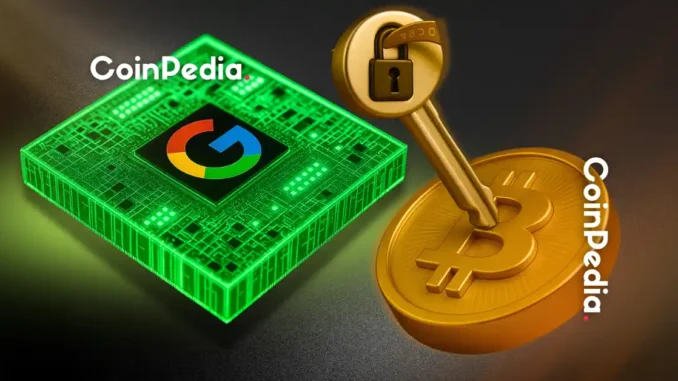

Google’s latest Quantum AI research has raised concerns about Bitcoin’s long-term security, warning that around 6.9 million BTC could become vulnerable when quantum computers grow powerful enough. The report highlights risks tied to exposed public keys and suggests the timeline for potential attacks may be shorter than previously expected.
Google Flags Quantum Risk to Millions of Bitcoin
According to the Google Quantum AI whitepaper, roughly 6.9 million Bitcoin may be exposed to future “quantum at-rest” attacks. About 1.7 million BTC are stored in older Pay-to-Public-Key (P2PK) addresses, where public keys are already visible on-chain. These include coins widely believed to belong to Bitcoin’s creator, Satoshi Nakamoto.
The concern is that once quantum computers become strong enough, attackers could derive private keys directly from public data. This would allow them to access dormant wallets without any transaction broadcast, creating a silent security risk.
Quantum Computers Could Break Keys Within Minutes
Google researchers estimate that a superconducting quantum computer could calculate a Bitcoin private key in around nine minutes. This falls just within Bitcoin’s average 10-minute block time, meaning attackers could potentially redirect transactions before confirmation.
The report also suggests the hardware requirements may be lower than expected. Earlier estimates required millions of qubits, but new models show attacks may be possible with fewer than 500,000 physical qubits. Some projections even indicate that 1,200–1,450 high-performance qubits could make such attacks feasible.
This significantly compresses the threat timeline and increases urgency for quantum-resistant solutions.
Massive Value at Risk if No Protocol Changes
The vulnerable pool represents nearly one-third of Bitcoin’s total supply, making it a major financial target. Google described these coins as a “fixed, multibillion-dollar target” if upgrades are not implemented before quantum breakthroughs arrive.
The paper also suggests governments may need legal frameworks for “digital salvage.” This would allow dormant coins to be protected before malicious actors gain access.
Analyst Says Bitcoin Can Adapt to Quantum Threat
Responding to the ongoing Quantum Threat, CryptoQuant analyst Darkfost said the risk is exaggerated. He explained that Bitcoin has improved over time with many address upgrades that made it more secure.
Today, about 78% of Bitcoin addresses use newer formats that hide public keys until the coins are spent, which adds extra protection.
He also said that each wallet would need to be hacked separately, so a large-scale attack would be very difficult. Even if some wallets were hacked, the overall Bitcoin network would likely still remain strong and continue working.
Darkfost also explained that quantum computing would not only affect Bitcoin. It could also threaten bank systems, government systems, and many other encrypted systems around the world.
Quantum Debate Adds Concern on Bitcoin Future Outlook
Meanwhile, Bitcoin, which is already struggling to build momentum around $66,000 after dropping from its all-time high. This growing quantum computing threat is now adding fresh concerns about Bitcoin’s long-term security and stability.
While no quantum computer capable of breaking Bitcoin exists today, the updated estimates suggest the industry may need to prepare sooner.
Trust with CoinPedia:
CoinPedia has been delivering accurate and timely cryptocurrency and blockchain updates since 2017. All content is created by our expert panel of analysts and journalists, following strict Editorial Guidelines based on E-E-A-T (Experience, Expertise, Authoritativeness, Trustworthiness). Every article is fact-checked against reputable sources to ensure accuracy, transparency, and reliability. Our review policy guarantees unbiased evaluations when recommending exchanges, platforms, or tools. We strive to provide timely updates about everything crypto & blockchain, right from startups to industry majors.
Investment Disclaimer:
All opinions and insights shared represent the author’s own views on current market conditions. Please do your own research before making investment decisions. Neither the writer nor the publication assumes responsibility for your financial choices.
Sponsored and Advertisements:
Sponsored content and affiliate links may appear on our site. Advertisements are marked clearly, and our editorial content remains entirely independent from our ad partners.


