


Bitcoin drops after Trump’s Truth Social threat turns ceasefire language into renewed escalation
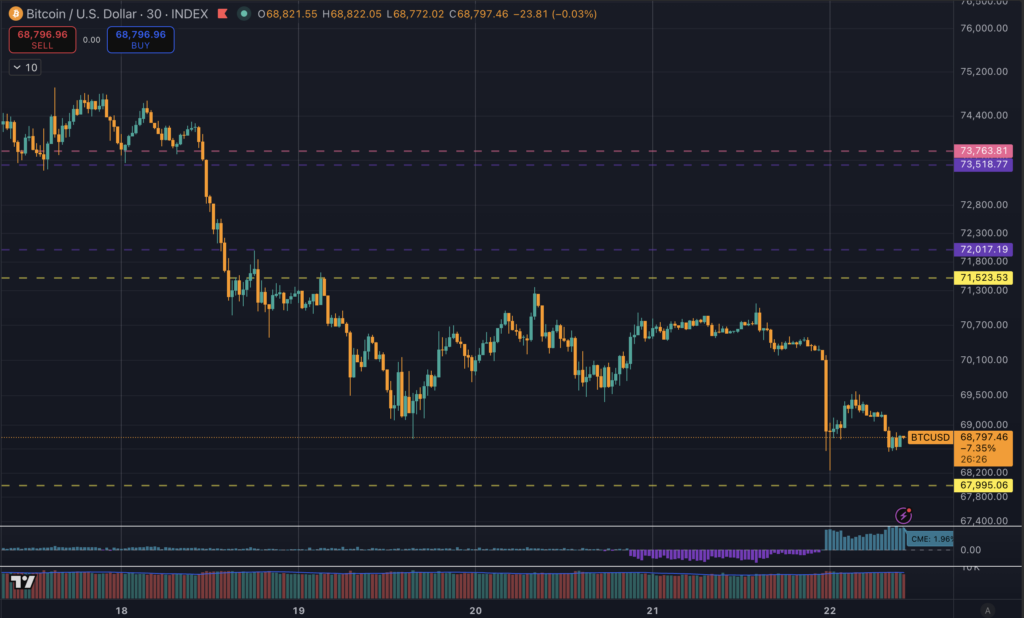
Overnight, Bitcoin dramatically fell 2.8% after President Donald Trump issued a Truth Social post threatening to “obliterate” Iran’s power plants if the Strait of Hormuz was not reopened within 48 hours.
The drop ran from roughly $70,400 to $68,200 before a partial rebound toward $69,500. By press time, Bitcoin had softened again to around $68,700. The sequence points to a discrete trigger. It was a fast repricing tied to a live geopolitical development that widened the escalation path just as markets had begun to price a less aggressive trajectory.
The immediate question is whether the move was a temporary air pocket or a more meaningful change in market structure. That distinction carries weight because Bitcoin had not been trading like a market in collapse.
Over the prior two weeks, it had shown a pattern of smaller drawdowns on larger war-related developments, and by last week Bitcoin was outperforming most major assets after initially selling off when the conflict began. Barron’s also noted that crypto had started to attract flows as a hedge against Iran-related geopolitical risk.
That is why Trump’s post stands out. It hit a market that had already built a recovery case around the idea that the first panic had been absorbed.
The useful question is whether the post interrupted a still-valid recovery structure, or reminded the market that the recovery had not yet earned acceptance above the range that counted.
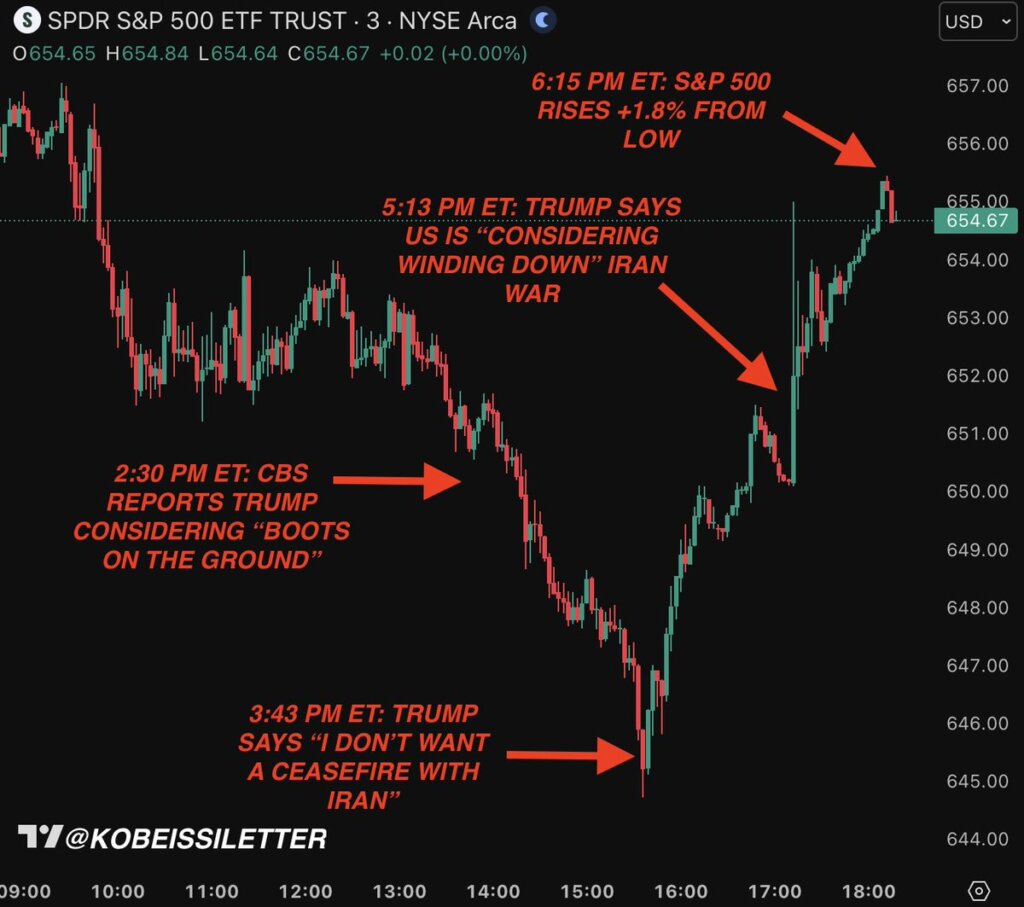
The post also carries extra force because of the sequence around it. Less than 24 hours earlier, Trump had been discussing the possibility of winding the war down. That did not amount to a ceasefire, and markets had little reason to treat it as one.
It still narrowed the perceived path of near-term escalation. The overnight shift back to a 48-hour ultimatum and a threat aimed at Iranian power infrastructure reversed that signal abruptly.
The administration had floated de-escalation while moving toward harder rhetoric and broader threats. Markets do not need a formal policy change to react to that kind of reversal.
The broader oil and rates backdrop remains relevant, though it sits in the background here. Weeks of reporting have already covered Hormuz, crude, inflation sensitivity, and the knock-on effects for broader risk assets. What changed overnight was the trigger.
The post introduced a more extreme rhetorical posture, pointed toward civilian energy infrastructure, and undercut the prior day’s softer tone. In market terms, that was new information. It changed the distribution of possible next moves, and Bitcoin repriced that distribution immediately.
Bitcoin is especially useful in moments like this because it trades continuously and reacts before other major markets can fully reset. During the opening phase of the Iran war, Bitcoin sold off first because it was the only large liquid market open when the conflict widened.
That leaves it functioning less as a settled safe-haven verdict and more as a fast transmission line. The asset often prices the shock first, then spends the next sessions showing whether the first reaction was exhaustion, overreaction, or the start of a deeper repricing.
So what does the structure show now? Bitcoin had been consolidating in a broad $62,800 to $72,600 range, with repeated failures above $70,000 and negative return skew prevailing until a decisive hold above that level is established.
Glassnode places the broader market between a Realized Price around $54,400 and a True Market Mean near $78,400. Put simply, Bitcoin had repaired a meaningful portion of the panic damage, while still falling short of a clean breakout. That limit still shapes the reading of the latest move.
That leaves the post-trigger drop easier to interpret. A fall from $70,400 to $68,200 carries significance because it pushed Bitcoin back below a level that still needed acceptance. In that sense, the market did not lose a confirmed breakout. It lost a test of one. The distinction is substantive.
A failed breakout carries broader structural consequences. A failed test is still a warning, though it sits one rung lower on the ladder. The data suggests this move belongs in the second category unless follow-through selling starts to damage the lower part of the range.
The second layer is market composition. Bitcoin dominance is holding near 58% while institutional positioning stayed concentrated in large caps. It also found that options open interest had overtaken perpetual futures, with traders leaning more heavily on protective structures after prior deleveraging.
That helps explain why the move was violent without yet turning disorderly. A more hedged market can still sell hard on geopolitical shock. What changes is the shape of the follow-through. The reaction becomes more surgical and less indiscriminate.
At the same time, there is little reason for complacency. The bear case is simpler than the bull case here.
If Trump’s post proves to be the first step in a new escalation sequence rather than a one-off threat, Bitcoin does not need a grand macro theory to trade lower. It only needs the market to decide that the conflict path has become harder to handicap.
That would keep the asset in its familiar role as a liquid shock absorber, pricing geopolitical uncertainty before traditional markets have fully reopened or rebalanced.
The base case is more restrained. It assumes the market has already repriced the post itself, while stopping short of confirming a larger structural breakdown. Under that framework, the important threshold is not the intraday low alone.
Whether Bitcoin can re-establish acceptance near $70,000 after being pushed away from it by the Truth Social escalation is critical. If it can, the move begins to look like a violent but temporary rejection driven by weekend geopolitical flow.
If it cannot, attention shifts back toward the lower half of Glassnode’s war range and the unresolved question of whether the recovery ever had real sponsorship behind it.
An escape hatch to the upside needs two conditions. First, the rhetoric has to cool, or at least stop worsening. Second, Bitcoin has to convert recovery into acceptance rather than another brief visit to the upper band. That is where the earlier resilience narrative comes back into focus.
Prior to this post, the market had begun treating Bitcoin less as a pure speculative beta trade and more as an asset capable of stabilizing after the first geopolitical hit. That reading has been dented by the latest move. It has not been erased by it.
The broader lesson is straightforward. Trump’s Truth Social post was the active market trigger. It took a market that had started to normalize the conflict and forced it to price a fresh escalation path, immediately and in size.
That is why the 2.8% drop deserves close attention. The move does not prove Bitcoin is weak. It also does not settle the debate around any safe-haven role.
It shows that abrupt rhetorical reversals from the White House can still knock Bitcoin out of a fragile recovery posture in minutes.
Bitcoin has not broken structurally, while still falling short of the standard needed to ignore this kind of geopolitical shock. The post exposed that limit clearly. The market had repaired damage. It had not secured acceptance.
That leaves one test ahead of the others, whether Bitcoin can reclaim the upper part of its range after a very public escalation shock, or whether this latest development will be remembered as the event that turned a recovery attempt back into a live credibility test.


