
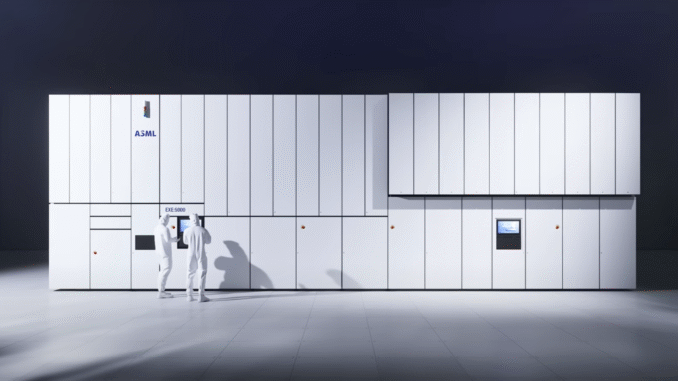
The machine that will make tomorrow’s AI chips possible has just been declared ready for mass production–and the clock for the industry’s next leap has officially started. ASML, the Dutch company that holds a global monopoly on commercial extreme ultraviolet lithography equipment, confirmed this week that its High-NA EUV tools have crossed the threshold from technically impressive to genuinely production-ready.
The announcement, made exclusively to Reuters by ASML’s chief technology officer Marco Pieters ahead of a technical conference in San Jose, marks a turning point that chipmakers and AI companies have been waiting years for.
Why this matters for AI
The timing is not incidental. Current-generation EUV machines are approaching the outer edge of what they can do for advanced AI chip production–meaning the semiconductors powering large language models and AI accelerators are bumping up against a physical ceiling.
High-NA EUV tools are designed to break through it, enabling chipmakers to print finer, denser circuit patterns in fewer steps. That translates directly into more powerful and efficient chips for AI workloads.
“I think that it’s at a critical point to look at the amount of learning cycles that have happened,” Pieters told Reuters, referring to the volume of customer testing the machines have now accumulated.
The numbers that matter
ASML’s case for readiness rests on three data points it plans to release publicly. The High-NA EUV tools have now processed 500,000 silicon wafers, achieved roughly 80% uptime–with a target of 90% by year-end–and demonstrated imaging precision capable of replacing multiple conventional patterning steps with a single High-NA pass.
Together, Pieters said, those figures signal that the tools are ready for manufacturers to begin qualification. The machines don’t come cheap. At approximately US$400 million per unit–double the cost of the previous EUV generation–they represent one of the most expensive pieces of capital equipment in industrial history.
TSMC and Intel are among the named early adopters.
A two-to-three-year runway
Technical readiness and manufacturing integration are two different things, and Pieters was careful to separate them. Despite the milestone, full integration into high-volume production lines is still expected to take two to three years as chipmakers work through qualification and process development.
“Chipmakers have all the knowledge to qualify these tools,” he said–a vote of confidence in the industry’s ability to move, even if the timeline remains measured.
For the AI sector, that means the next generation of chip performance improvements is on the horizon, not yet in hand. But with ASML now saying the starting gun has fired, the race to integrate High-NA EUV into production has formally begun.
(Photo by ASML)
See also: 2025’s AI chip wars: What enterprise leaders learned about supply chain reality
Want to learn more about AI and big data from industry leaders? Check out AI & Big Data Expo taking place in Amsterdam, California, and London. The comprehensive event is part of TechEx and co-located with other leading technology events. Click here for more information.
AI News is powered by TechForge Media. Explore other upcoming enterprise technology events and webinars here.



