


Crypto funds recorded a fourth consecutive week of net outflows, shedding $173 million, as investor caution persisted across major digital assets.
However, the pace of withdrawals has slowed markedly from the heavy selling seen in late January and early February, while select altcoins have continued to attract fresh capital.
Sponsored
Sponsored
Crypto Outflows Persist but Slow from January Peaks
According to the latest weekly fund flows report from CoinShares, cumulative outflows over the past four weeks have reached $3.74 billion, reflecting sustained weak sentiment following earlier market volatility.
While outflows continued, last week’s figure was broadly in line with the previous week’s $187 million decline, suggesting the sharp liquidation phase may be easing.
Earlier in the cycle, digital asset funds experienced much steeper withdrawals, including roughly $1.7 billion in each of the final weeks of January.
Market activity also cooled significantly, with ETF trading volumes dropping to $27 billion, down sharply from the record $63 billion reported the week before.
The decline in turnover suggests investors may be stepping back from aggressive repositioning, even as broader uncertainty persists.
Despite the overall negative flows, sentiment improved slightly toward the end of the week. Softer-than-expected US inflation data helped spark $105 million in inflows on Friday.
“Sentiment improved slightly on Friday following weaker-than-expected CPI data,” wrote James Butterfill, head of research at CoinShares.
This suggests macroeconomic signals continue to play a decisive role in shaping short-term crypto demand.
Sponsored
Sponsored
Regional Divergence Becomes More Pronounced as Bitcoin and Ethereum Lead Withdrawals
One of the most notable trends in the latest data was a widening regional divide. The US accounted for $403 million in outflows. This made it the primary driver of the global decline.
While US investors remain cautious, potentially reflecting macro uncertainty and positioning shifts, institutions in other markets may be viewing the recent price weakness as an opportunity to accumulate.
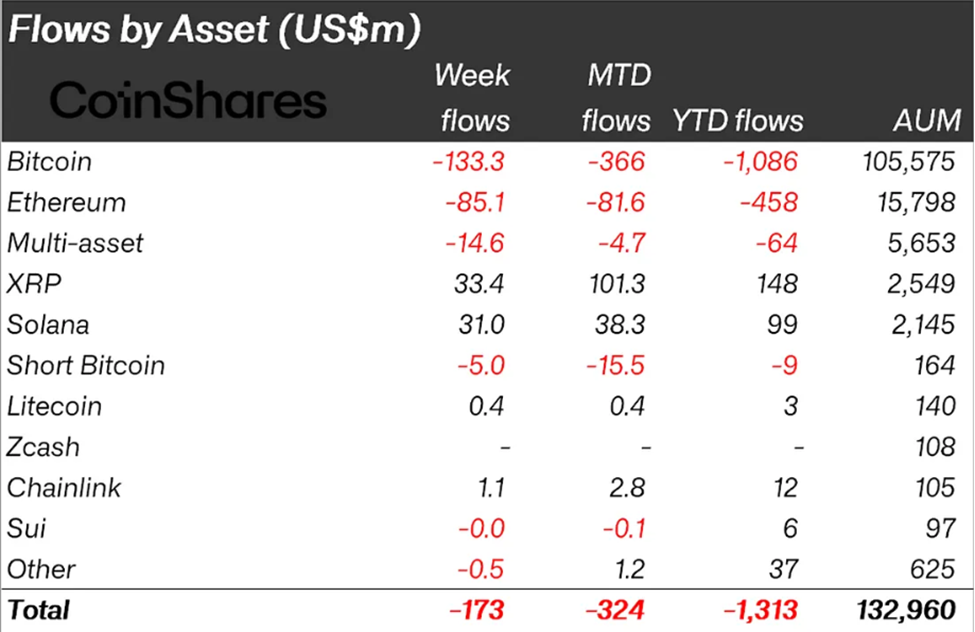
Meanwhile, the largest digital assets continued to bear the brunt of negative sentiment. Bitcoin investment products saw $133 million in outflows, the weakest performance among major assets.
Sponsored
Sponsored
Interestingly, short Bitcoin products also recorded outflows totaling $15.4 million over the past two weeks.
Historically, declines in demand for bearish positions have sometimes coincided with periods of market capitulation. Therefore, it may signal that the worst of the selling pressure could be nearing exhaustion.
Ethereum funds also struggled, posting $85.1 million in outflows as investors reduced exposure to the second-largest crypto. Smaller products were not immune either, with Hyperliquid seeing modest withdrawals of around $1 million.
Altcoins Show Signs of Rotation
In contrast to the broader trend, several altcoins continued to attract capital. XRP led inflows at $33.4 million, followed closely by Solana at $31 million, while Chainlink added $1.1 million.
Sponsored
Sponsored
These inflows point to a selective rotation rather than a wholesale exit from the crypto sector. Investors appear to be reallocating toward assets perceived to have stronger narratives or relative momentum, even as exposure to larger-cap tokens declines.
Taken together, the latest data paints a picture of a market still under pressure but stabilizing compared with the intense selling seen earlier in the year.
Crypto outflows remain persistent, yet their reduced scale, coupled with regional inflows and continued interest in certain altcoins, suggests investors are adjusting portfolios rather than abandoning the asset class outright.


