


Bitcoin took a symbolic step into the US central bank on Thursday as President Donald Trump nominated Dr. Stephen Miran, the White House Council of Economic Advisers chair, to fill a vacant seat on the Federal Reserve Board of Governors through January 31, 2026, pending Senate confirmation. The short-term appointment follows the early resignation of Governor Adriana Kugler and gives the White House an immediate voice at the Board while a longer-run personnel shuffle—most notably the question of who succeeds Chair Jerome Powell when his chairmanship ends on May 15, 2026—continues to loom.
Miran’s résumé straddles markets and policy. Before becoming CEA chair, he served at Treasury during the pandemic and worked in macro investing; he has since published work proposing to overhaul Fed governance—arguing the central bank has drifted into “groupthink” and “excessive monetary accommodation.” In a 2024 Manhattan Institute report he and coauthors urged shorter Board terms, clarified presidential removal authority, more power for the Reserve Banks, and bringing the Fed’s budget under congressional appropriations—changes they say would deliver “better monetary outcomes” while restoring democratic accountability.
Markets and macro watchers immediately tried to triangulate what Miran’s arrival means for the near-term policy mix. The practical impact could be bounded by the calendar—his term runs only through January 31, 2026, covering a handful of FOMC meetings—but the symbolism is not: the nomination lands as the White House has pressed for rate cuts and previewed a broader reshaping of the Fed after Powell’s term as chair ends next May. Miran is a like-minded voice now while the administration canvasses candidates for the chair.
Miran has been an outspoken critic of the Fed’s pandemic-era stance and its later framework pivot; the Manhattan Institute paper faults the central bank’s “excessive monetary accommodation” and its dismissal of early inflation as “transitory.” He has also argued, in interviews and policy essays, for rebalancing the international monetary system and for tariffs as a tool to shift burden-sharing without deliberately weakening the dollar—positions that put him squarely inside the current administration’s macro playbook.
‘Bitcoin Fixes This’ – Miran
Bitcoin circles seized on the appointment for a different reason: Miran has, on multiple occasions, echoed a popular Bitcoin refrain. On Aug. 18, 2023, he posted “Bitcoin fixes this” from his personal account, and social-media archivists circulated a separate Jan. 9, 2022 instance of him writing “Bitcoin fixes this.”
That posture tracks with remarks Miran made in late 2024 about the role of financial deregulation—as well as Bitcoin and crypto specifically—in a growth agenda. In a December 2024 interview on The Bitcoin Layer, he said: “Financial deregulation is going to be a powerful part of that. I think that crypto has a big role potentially to play in innovation.” (The conversation is widely excerpted and summarized in crypto trade coverage.)
Reaction across X was swift. MacroScope called the pick “Huge. I’ve posted about Miran before. Always been a fan.” Steven Lubka, the Vice President of Investor Relations at Nakamoto, highlighted the archival Bitcoin posts: “A future member of the Federal Reserve board has tweeted ‘Bitcoin Fixes This’”. Alex Gladstein of the Human Rights Foundation, a prominent Bitcoin advocate and Fed skeptic, simply wrote: “Strange times.”
Beyond the headline Bitcoin angle, Miran’s publication record suggests he will push internally on two axes: governance and scope. In a Mercatus Center discussion last year, he criticized large-scale asset purchases for eroding the line between fiscal and monetary policy, a theme echoed in his Manhattan Institute report’s call to “cordon off” non-monetary functions from the FOMC and to restore a narrower, technocratic focus on price stability. Those proposals—shortening Board terms, clarifying presidential removal, strengthening Reserve Banks, and subjecting the Fed’s operating budget to appropriations—would together amount to the most consequential redesign of the Fed’s institutional architecture in decades.
For now, the practical timeline is straightforward. The seat Miran would occupy is the remainder of Kugler’s term ending January 31, 2026; confirmation is required, and the calendar means he could be seated for only a few meetings before the next inflection point in Fed leadership. Powell’s term as chair ends May 15, 2026, though his underlying Board tenure runs to January 31, 2028, and presidents historically signal chair choices months in advance. Today’s interim move, therefore, looks less like a capstone than the first placement in a larger chess game over the central bank’s direction into 2026.
At press time, Bitcoin traded at $116,550.
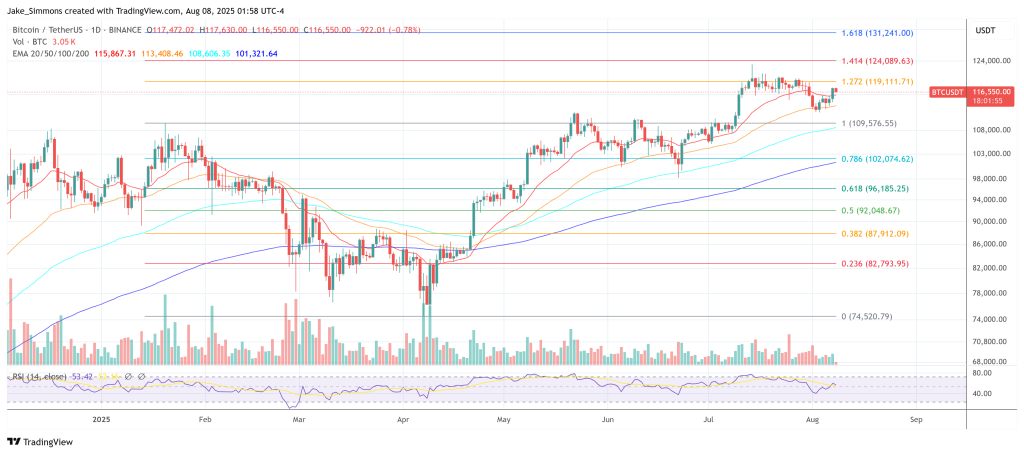
Featured image created with DALL.E, chart from TradingView.com

Editorial Process for bitcoinist is centered on delivering thoroughly researched, accurate, and unbiased content. We uphold strict sourcing standards, and each page undergoes diligent review by our team of top technology experts and seasoned editors. This process ensures the integrity, relevance, and value of our content for our readers.


