

U.S. lawmakers have introduced the bipartisan PREDICT Act to stop senior government officials from trading on political prediction markets.
The proposal would ban the president, vice president, members of Congress, and political appointees, along with spouses and dependents, from profiting on government-related outcomes.
PREDICT Act Seeks to Ban Political Prediction Market Trading
According to the March 25 proposal, Representatives Adrian Smith and Nikki Budzinski introduced the Preventing Real-time Exploitation and Deceptive Insider Congressional Trading (PREDICT) Act. The bill targets prediction market trading tied to political events, policy decisions, and government actions.
The restrictions would apply to members of Congress, the president, vice president, executive branch officials, and their spouses and dependent children. Lawmakers argue that officials with access to sensitive information could gain an unfair advantage by betting on policy outcomes.
The bill also outlines penalties for violations. Anyone covered under the rule could face a 10% fine based on contract value and would be required to give up all profits from the trade. The recovered funds would be sent to the U.S. Treasury.
Lawmakers Raise Concerns Over Insider Information
Supporters of the bill say prediction markets have recently drawn attention after traders reportedly made large profits from geopolitical events and policy decisions. These include contracts tied to war developments, government shutdowns, and regulatory outcomes.
Lawmakers argue that individuals with access to non-public information could influence markets or benefit from early knowledge.
The PREDICT Act aims to close this gap and ensure public officials do not profit from their roles.
Pressure Builds on Prediction Market Platforms
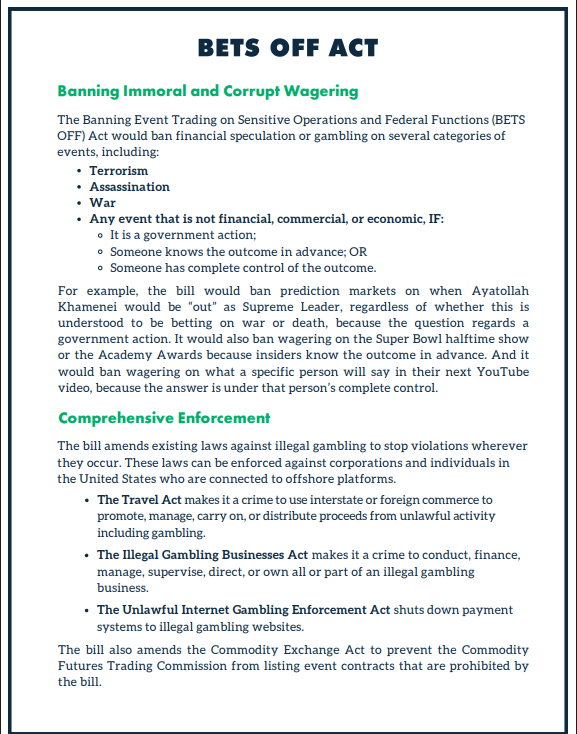
The PREDICT Act comes alongside other legislative efforts targeting prediction markets. Earlier this month, another proposal, the BETS OFF Act, aimed to restrict trading tied to sensitive government operations.
At the same time, multiple U.S. states have taken action against prediction markets. Reports indicate 11 states have launched legal actions, while two additional states are considering similar steps.
Federal lawmakers have also raised concerns about contracts that resemble sports betting or casino-style markets. Some proposals would restrict regulated entities from listing such products.
If passed, the PREDICT Act would significantly limit who can trade on political outcomes. It would also tighten oversight around insider information risks.
Trust with CoinPedia:
CoinPedia has been delivering accurate and timely cryptocurrency and blockchain updates since 2017. All content is created by our expert panel of analysts and journalists, following strict Editorial Guidelines based on E-E-A-T (Experience, Expertise, Authoritativeness, Trustworthiness). Every article is fact-checked against reputable sources to ensure accuracy, transparency, and reliability. Our review policy guarantees unbiased evaluations when recommending exchanges, platforms, or tools. We strive to provide timely updates about everything crypto & blockchain, right from startups to industry majors.
Investment Disclaimer:
All opinions and insights shared represent the author’s own views on current market conditions. Please do your own research before making investment decisions. Neither the writer nor the publication assumes responsibility for your financial choices.
Sponsored and Advertisements:
Sponsored content and affiliate links may appear on our site. Advertisements are marked clearly, and our editorial content remains entirely independent from our ad partners.


