


Ethereum has reclaimed the $2,000 level after several weeks of volatile price action, offering the market a brief period of relief following sustained selling pressure across the broader crypto sector. The recovery comes as derivatives activity begins to normalize, suggesting that leverage levels may be stabilizing after months of structural shifts in the Ethereum futures market.
A recent report from CryptoQuant analyst Arab Chain highlights notable developments in Ethereum’s derivatives positioning. Data from the ETH Open Interest Z-Score (30-day rolling) on Binance shows meaningful changes in market structure in recent months, particularly in how traders deploy leverage.
According to the latest reading, total open interest in Ethereum contracts on Binance has reached approximately $4.26 billion, while the 30-day moving average stands near $4.18 billion. Over the same period, the standard deviation measures roughly $285.8 million.
These figures place the Z-Score around 0.29, a moderate reading that indicates open interest currently sits close to its historical average. In practical terms, the data suggests that the market is not experiencing extreme leverage conditions.
Ethereum Derivatives Market Shows Signs of Structural Reset
The report also highlights a deeper shift unfolding in Ethereum’s derivatives market. One of the most notable signals appears in the 30-day moving average of open interest, which has declined to its lowest level since May 2025. While the headline number may look modest, the trend behind it reveals an important structural adjustment in market positioning.’

Falling open interest generally indicates that traders are closing positions faster than new ones are opening. In Ethereum’s case, the gradual decline suggests that leverage has steadily drained from the market over recent months rather than collapsing in a single liquidation event. This process often follows extended periods of volatility, when traders reduce exposure and risk appetite fades across derivatives platforms.
The change also points to a potential shift in market composition. When speculative liquidity exits futures markets, activity tends to move toward spot accumulation or lower-risk strategies. That dynamic can temporarily suppress momentum but often leaves the market structurally healthier.
In practical terms, Ethereum’s derivatives market now appears less crowded and less dependent on leveraged positioning. Historically, such resets tend to occur near transitional phases in market cycles. If new liquidity enters the market and risk appetite returns, the current reduction in leverage could provide a cleaner foundation for the next expansion in derivatives activity.
Ethereum Price Tests Critical Support After Sharp Correction
Ethereum currently trades near the $2,050 level after a sharp correction that followed the late-2025 rally. The weekly chart shows ETH recovering modestly after briefly dropping below the psychological $2,000 mark, a level that has historically acted as an important support and resistance zone during previous market cycles.
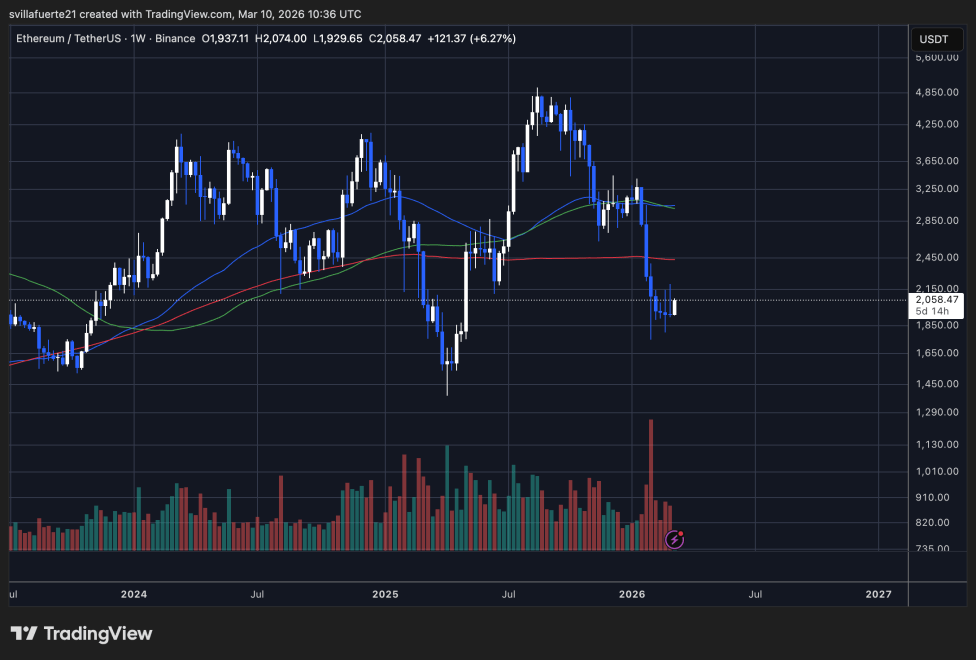
The broader structure suggests that Ethereum remains in a corrective phase after peaking near the $4,800 region in 2025. Since that high, the market has printed a sequence of lower highs and declining momentum, reflecting a shift in market sentiment as macro conditions and crypto liquidity tightened.
Technically, ETH now sits below the 50-week and 100-week moving averages, which currently act as overhead resistance in the $2,800–$3,000 range. The 200-week moving average near $2,450 also represents a key structural level that the market recently lost during the sell-off. Losing that long-term support accelerated downside volatility and triggered the high-volume capitulation visible on the chart.
Despite the bearish pressure, the recent bounce near $1,900 suggests buyers are defending the lower range of the current structure. If Ethereum manages to reclaim the 200-week moving average, the market could attempt a broader recovery toward the $2,800 resistance zone.
Featured image from ChatGPT, chart from TradingView.com

Editorial Process for bitcoinist is centered on delivering thoroughly researched, accurate, and unbiased content. We uphold strict sourcing standards, and each page undergoes diligent review by our team of top technology experts and seasoned editors. This process ensures the integrity, relevance, and value of our content for our readers.


