


A thread sparked by Bloomberg ETF analyst Eric Balchunas reignited one of crypto’s oldest arguments: whether Bitcoin’s core value proposition has been diluted as institutional intermediaries take center stage. What began as a reflection on crypto’s real-world utility quickly turned into a pointed dispute over whether BTC can credibly be called “debasement-resistant” while it remains wildly volatile.
Bitcoin Identity Debate Explodes on X
Balchunas weighed in after Cooper Turley, founder of Coop Records, posted that crypto feels “in the weirdest spot” since 2017 and that beyond speculation it’s “hard to see how it adds meaningful value to people’s lives.” Balchunas’ response framed Bitcoin’s novelty less as a product category and more as a monetary property set.
“Seeing this a lot. My two cents: the novel value of bitcoin is that it is user-run money that is both censorship and debasement-resistant,” Balchunas wrote. “Far as I can tell nothing has changed about that. However bc the current admin is so on board with it, the censorship part may seem less valuable, but just wait a few yrs, that could come in handy (it already does in many emerging/frontier mkt countries).. and debasement is alive and well, even dogs know that ain’t ever stopping.”
He argued that Bitcoin’s “youth” is a major driver of volatility, and that market price tends to hijack the narrative. “Price is a smoke screen that the most successful investors have learned to see through/ignore,” he added, extending the critique to traditional markets as well.
The “co-opted” question surfaced explicitly when Balchunas addressed long-time holders uneasy with BTC being increasingly accessed through Wall Street wrappers. His take: the asset didn’t change; the gatekeepers did.
“And for the OGs feeling like the establishment has co-opted their ‘outsider’ money.. all that really happened was the intermediaries got upgraded,” Balchunas wrote. “You went from paying high fees to SBF only for him to ‘lose’ your money to Larry Fink et al, who do same thing (outsourced your btc) but in a way that’s much cheaper and safer. Underlying btc hasn’t changed at all the whole time.”
Is Bitcoin Still A Debasement-Trade?
That framing didn’t satisfy critics who see Bitcoin’s volatility as fatal to the “debasement-resistant” label. Host of Chicago Future of Finance Oliver Renick pushed back sharply, arguing that a money that can swing the way Bitcoin does is effectively experiencing repeated “debasement events” by any practical standard.
“Debasement-resistant is biggest error here IMO,” Renick wrote. “If the dollar were down as much as btc can do on any given week, the world would go nuts, i.e, bitcoins volatility goes thru a debasement event like 3 times a year compared to the dollar where a 2% is a big deal. It’s rly bad money.”
Balchunas conceded the point partially on timeframe: “I think more longer term but it’s a fair point” but the exchange escalated when Renick questioned Bitcoin’s staying power. “And there it gets crushed again versus dollar and gold. Bitcoin may not make it to its 20th birthday, who knows,” he wrote.
Balchunas responded by pointing to recent performance as evidence that Bitcoin has “banked” substantial gains, citing “2023 and 2024” and “450%.” Renick’s rebuttal remained categorical: “Again , volatility intolerable of money.” Balchunas agreed Bitcoin is “too volatile rn to be widespread currency” and needs to “mature and settle down,” but rejected the conclusion that this reduces Bitcoin to censorship resistance alone.
“So that leaves you with just censorship resistance,” Renick wrote, suggesting that value might be far lower — “maybe $10k a coin” — before Balchunas returned to first principles: “It is debasement resistant, govt can’t dilute it- that’s true even if it is volatile.”
Balchunas closed by challenging the idea that shorter windows are dispositive, contrasting gold’s “20%” rise in “2023 + 2024” with Bitcoin’s “450%” move, and returning to the “young asset” thesis: it “gets ahead of itself then falls.”
The thread leaves a familiar fault line exposed. For Balchunas, institutional plumbing doesn’t change Bitcoin’s properties, and volatility is a maturity problem that can coexist with long-term dilution resistance. For critics, volatility isn’t a side effect, it’s the disqualifier, collapsing the “money” narrative and forcing a narrower censorship-resistance-only valuation debate.
At press time, BTC traded at $66,207.
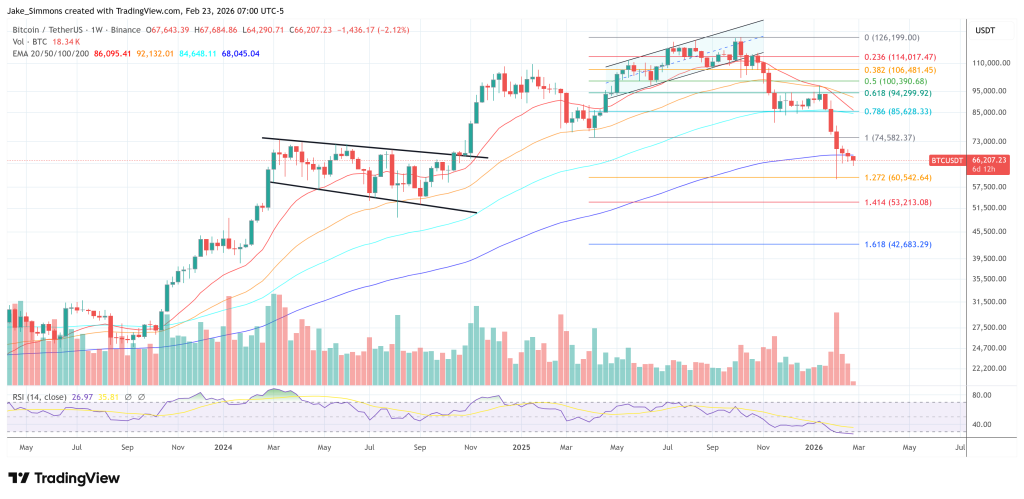
Featured image created with DALL.E, chart from TradingView.com

Editorial Process for bitcoinist is centered on delivering thoroughly researched, accurate, and unbiased content. We uphold strict sourcing standards, and each page undergoes diligent review by our team of top technology experts and seasoned editors. This process ensures the integrity, relevance, and value of our content for our readers.


