


The crypto market is entering a critical phase as persistent selling pressure and rising fear continue to dominate sentiment across digital assets. Price action has remained fragile in recent weeks, with both major cryptocurrencies and altcoins struggling to regain sustained momentum. Investors are increasingly cautious as liquidity tightens, volatility persists, and macro uncertainty weighs on risk appetite. While corrective phases are not unusual after strong rallies, the current environment suggests the market is still searching for stability rather than transitioning into a clear recovery.
A recent CryptoQuant report highlights a significant regulatory development that could influence longer-term market structure. Ripple CEO Brad Garlinghouse recently indicated there is roughly a 90% probability that the CLARITY Act will pass by the end of April. The Digital Asset Market Clarity Act aims to define the regulatory boundary between the SEC and CFTC, establish clearer registration frameworks for exchanges and brokers, formalize custody and asset segregation rules, and codify AML and KYC requirements.
Progress has slowed primarily due to debate around stablecoin yield products. While some proposals restrict issuers from paying interest, banks argue that exchange-based rewards may function as indirect yield instruments. Meanwhile, on-chain data shows yield-bearing stablecoin supply expanding rapidly since late 2024, highlighting growing structural demand.
Regulatory developments are increasingly shaping sentiment across the crypto market, and recent analysis suggests that the rapid growth of yield-bearing stablecoins has intensified political and financial tensions. Crypto firms are attempting to draw a distinction between interest paid directly by issuers and rewards distributed through exchanges or platforms, arguing that these mechanisms serve different economic functions.

Traditional banks, however, are advocating for tighter restrictions, concerned that such products could accelerate deposit outflows from the conventional financial system. Until compromise language is formally codified in legislation, momentum within the Senate remains uncertain.
At the same time, legislative complexity continues to increase. The Senate Agriculture Committee has already advanced a separate text focused primarily on Commodity Futures Trading Commission oversight. This creates a scenario in which multiple legislative packages will eventually need to be reconciled. Bipartisan vote requirements, questions around federal versus state regulatory authority, and unresolved provisions related to decentralized finance further complicate the timeline. These factors suggest that even broadly supported frameworks may face procedural delays.
If enacted, the Digital Asset Market Clarity Act could reduce regulatory risk premiums in the short term while gradually reshaping market structure over the longer horizon. However, clarity is unlikely to emerge instantly. Historically, regulatory transitions unfold sequentially — first through political signaling, then formal rulemaking, and ultimately enforcement. Until that process matures, regulatory uncertainty will remain embedded in the market environment.
Total Crypto Market Cap Tests Structural Support
The total cryptocurrency market capitalization continues to face downward pressure, with the weekly chart showing a clear rejection from the multi-trillion-dollar peak reached during the 2025 rally. After topping near the $4 trillion region, the market has entered a sustained corrective phase, recently pulling back toward the $2.3 trillion area. This zone now functions as a key structural support level, reflecting the midpoint between the previous expansion phase and the ongoing consolidation.
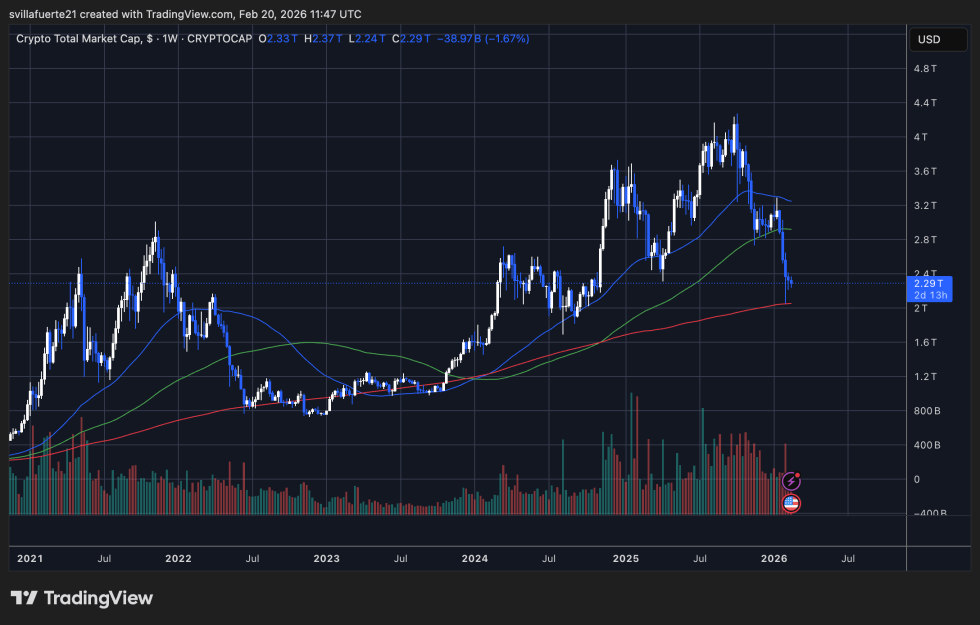
Technically, price action remains below the shorter-term moving averages, which have begun to slope downward and act as dynamic resistance. The medium-term average is flattening, suggesting loss of bullish momentum, while the longer-term trend line still trends upward but with a lag typical of macro support indicators. Until capitalization reclaims these levels decisively, upside follow-through may remain limited.
Volume patterns also reflect caution. Participation has moderated compared with the peak rally phase, although occasional spikes suggest intermittent repositioning rather than uniform capitulation. Historically, such environments often precede extended consolidation periods as excess leverage unwinds.
If support near current levels holds, the market could enter a stabilization phase. A breakdown below this zone, however, would likely confirm continued corrective pressure across the broader crypto ecosystem.
Featured image from ChatGPT, chart from TradingView.com

Editorial Process for bitcoinist is centered on delivering thoroughly researched, accurate, and unbiased content. We uphold strict sourcing standards, and each page undergoes diligent review by our team of top technology experts and seasoned editors. This process ensures the integrity, relevance, and value of our content for our readers.


