
Over $8.72 billion in Bitcoin and Ethereum options expire today, marking February’s largest derivatives event.
The expiring options place the crypto market at a critical inflection point, with volatility elevated and sentiment fragile.
February’s $8.72 Billion Expiry Crossroads: Will Bitcoin and Ethereum Face the Pain Trade?
Bitcoin accounts for the lion’s share of the exposure, with 114,705 contracts representing $7.74 billion in notional value heading into settlement.
Ethereum follows with 478,992 contracts worth approximately $975 million. Combined, the expiries account for roughly 20% of total open interest, suggesting their potential market impact.
At current prices, both assets sit notably below their respective “max pain” levels or the strike price at which the greatest number of options expire worthless.
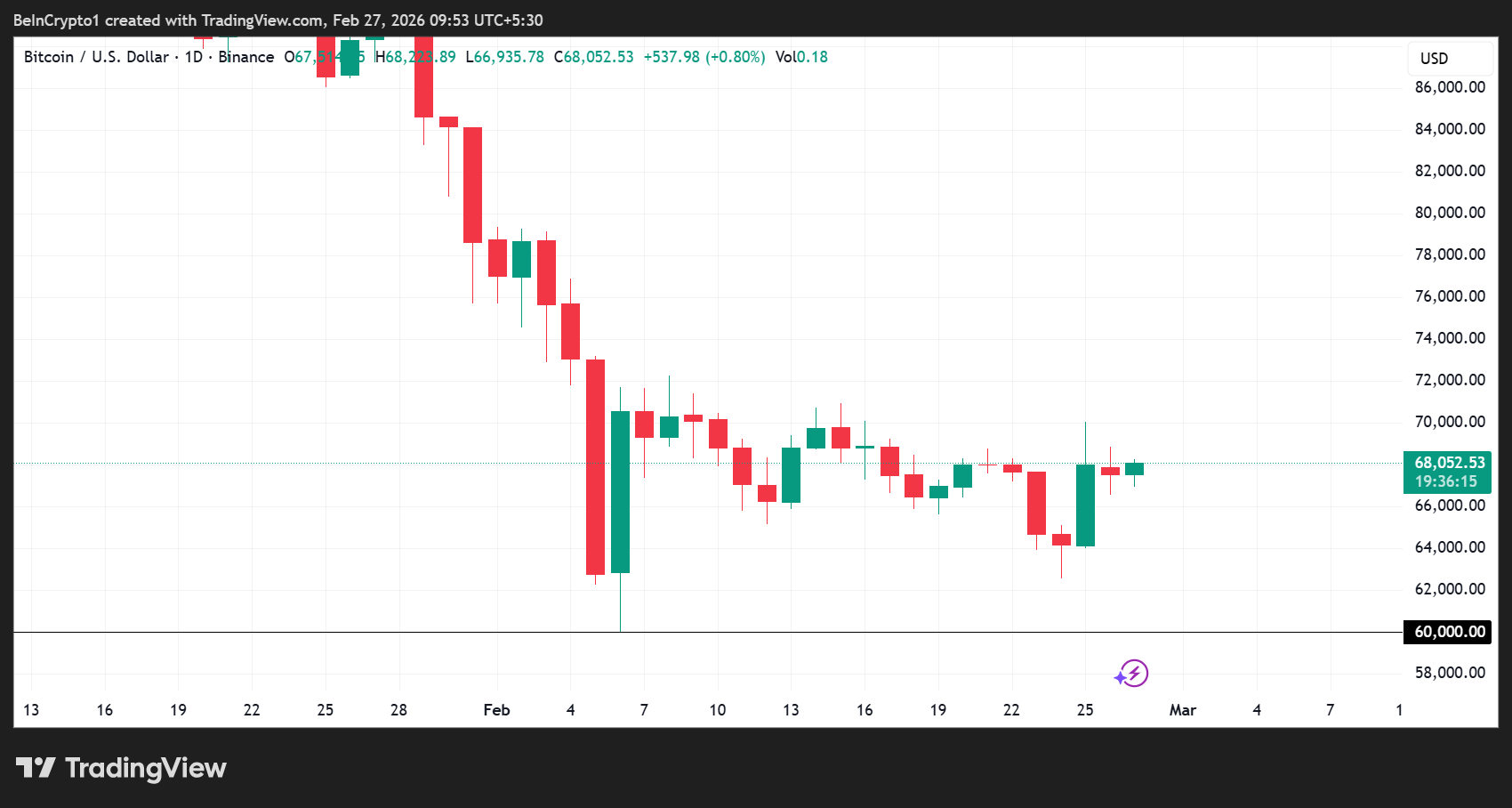
Bitcoin was trading for $68,052, compared to a max pain level of $75,000. Ethereum changes hands near $2,035, below its $2,200 max pain threshold.
Call open interest (OI) dominates across both assets. Bitcoin shows 66,300 call contracts versus 48,405 puts, giving a put-to-call ratio of 0.73. Ethereum’s ratio stands at 0.78, with 268,642 calls and 210,350 puts outstanding.
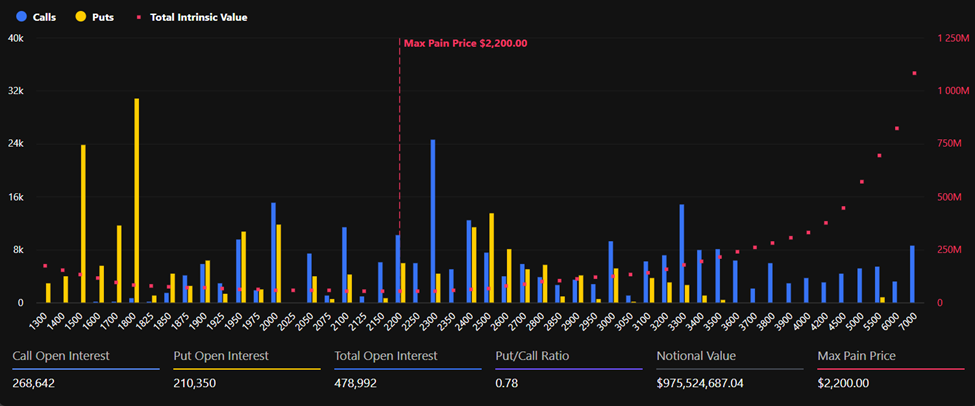
Analysts at Deribit note that call OI leads across both majors, with Bitcoin carrying the significantly larger notional weight into settlement. This factor could amplify spot sensitivity if hedging flows intensify.
Volatility Divergence Signals Unease
Meanwhile, volatility metrics reveal a nuanced picture. According to Deribit data, Bitcoin’s DVOL index sits at 53, with an implied volatility (IV) percentile of 87.7, which is elevated relative to its historical range.
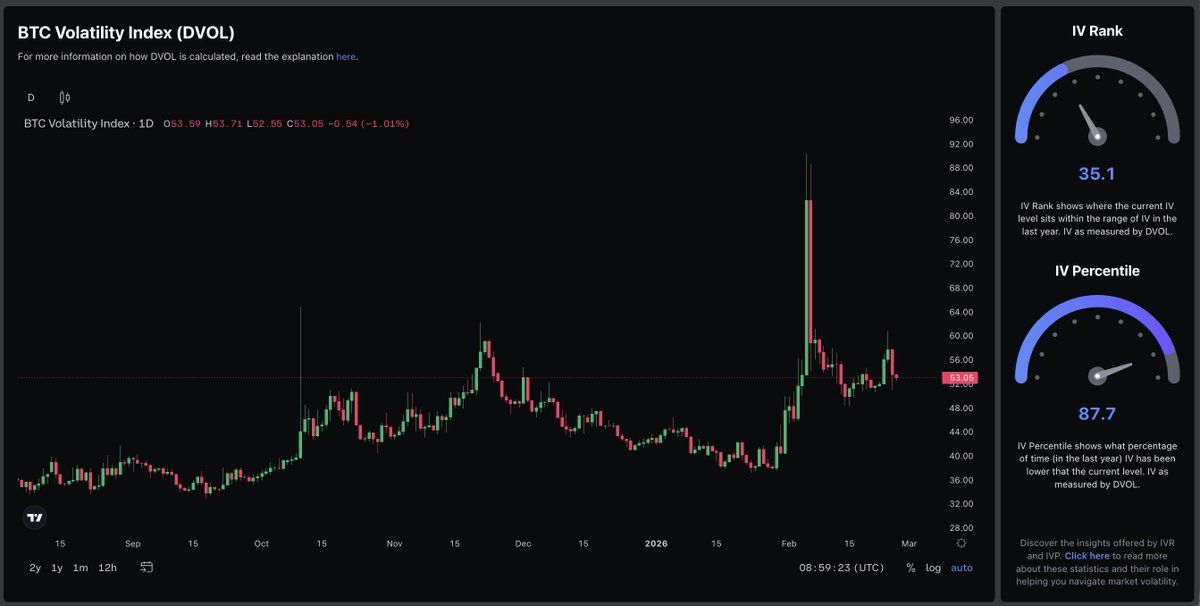
Ethereum’s DVOL is higher in absolute terms at 70, but its IV percentile of 55.7 suggests it is less extreme than its historical behavior.
Still, Ethereum volatility is running approximately 15–20 points above Bitcoin across the curve. It indicates traders are pricing in materially higher uncertainty across ETH maturities.
Term structure remains in contango for both assets, with a front-end volatility premium concentrated around the February expiry.
Fear Unwinds, But Conviction Lags
Earlier this month, 25-delta skew for both Bitcoin and Ethereum plunged toward -30, reflecting intense demand for downside protection as prices slid sharply.
Since then, skew has steadily recovered to around -8 to -9, signaling that panic hedging has eased. However, skew remains negative, indicating the market has not fully shaken off its defensive posture. Against this backdrop, analysts at Greeks.live describe the broader market as sluggish.
In early February, Bitcoin briefly tested the $60,000 psychological threshold and has since oscillated weakly above it.
While a recent two-day rebound lifted implied volatility (with BTC main-term IV at 47% and ETH at 65%) confidence remains thin.
“The downward price trend has eased, but market confidence remains insufficient,” Greeks.live noted, adding that large-block call options have dominated recent trading activity, particularly in medium- to long-term maturities.
Skew metrics rebounding indicates emerging bottom-fishing activity, but the firm cautions that the market remains firmly in bear territory.
Crucially, analysts argue that the crypto market lacks fresh capital inflows and clear catalysts, with pessimistic narratives still dominating social channels. Despite signs that extreme fear is unwinding, conviction behind the rebound appears tentative.
With both Bitcoin and Ethereum trading well below their max pain levels, spot prices could gravitate higher heading into today’s options expiry. Such an outcome could intensify a potential “pain trade.”
However, subdued demand could allow volatility to compress after expiry, with derivatives markets pricing less panic, but not yet a return of confidence.


